

By: Fjóla Dögg Helgadóttir
If you work with clients, chances are you have already had someone with Misophonia or Misokinesia sitting in your office, even if neither of you realized it. They may experience intense distress at the sound of someone chewing, sniffing or tapping, or at the sight of a leg bouncing under the table. Yet they may never mention it, perhaps because they do not want to offend you by asking you to stop.
These experiences often emerge almost apologetically, accompanied by embarrassment or guilt. I know this contrast myself. I love downhill skiing, mountain biking, and skydiving, really anything that gets the adrenaline going. Yet tiny, everyday sounds can sometimes bother me intensely. It can feel strangely inconsistent with the rest of who you are, which can make it surprisingly difficult to talk about.
What are Misophonia and Misokinesia?
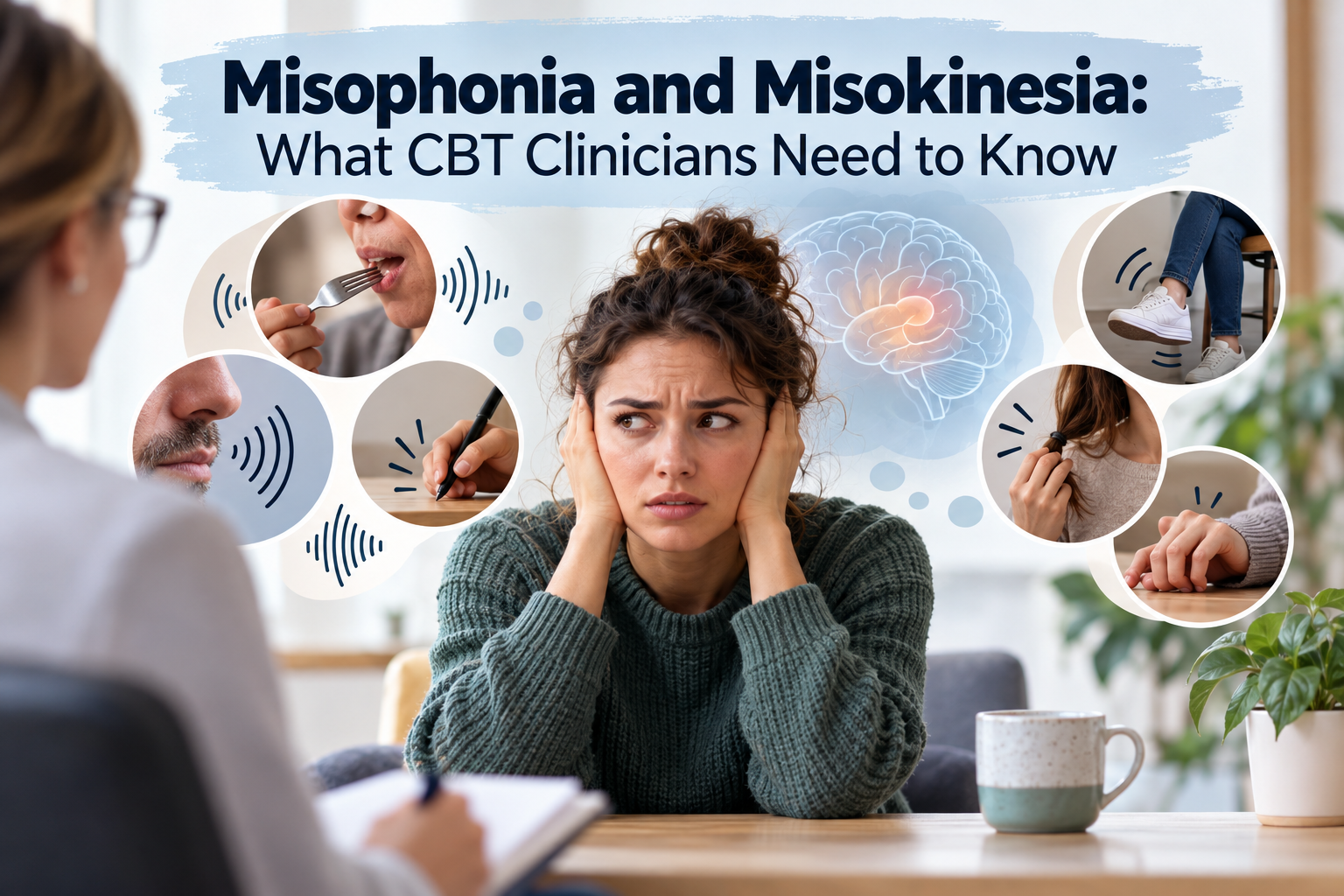
Misophonia involves decreased tolerance to particular sounds or stimuli associated with them. Common triggers include eating sounds, snoring, sniffling, throat clearing, loud breathing, tapping and clicking. An international consensus definition describes reactions as potentially including anger, disgust, anxiety and physiological arousal, alongside behavioural responses such as escaping or avoiding triggers (Swedo et al., 2022).
Misokinesia involves strong negative reactions to seeing particular repetitive movements, such as someone shaking their leg, playing with their hair, tapping their fingers or fidgeting. Misophonia and Misokinesia can occur together, although either can also occur without the other (Jaswal et al., 2021). Because clients may not spontaneously mention visual triggers, it can be useful to ask not only, “Which sounds bother you?” but also, “Are there particular movements that bother you?”
How common are they?
Neither Misophonia nor Misokinesia is currently a distinct diagnosis in the DSM-5-TR or ICD-11. Assessment therefore relies on clinical judgement, formulation and dimensional measures rather than formal diagnostic criteria.
Sensitivity itself appears surprisingly common. In a representative German study of more than 2,500 people, approximately 1 in 3 reported sensitivities to at least one misophonic sound (Pfeiffer et al., 2025). Importantly, sensitivity varied considerably in severity, and substantially fewer people experienced moderate or severe symptoms.
Misokinesia may also be surprisingly common. Across three studies involving more than 4,100 participants, approximately 1 in 3 reported some degree of sensitivity to seeing other people fidget (Jaswal et al., 2021).
These findings highlight an important clinical distinction: sensitivity can be common without necessarily being severe or impairing.
Thinking about it in CBT terms
For CBT clinicians, perhaps the most useful starting point is formulation.
A human-generated sound or movement can trigger an immediate emotional and physiological response. Importantly, the initial response is not something the person simply chooses. Neuroimaging research has found that trigger sounds in people with Misophonia are associated with heightened activation of the anterior insular cortex, altered connectivity with other brain regions involved in emotion processing, and increased physiological arousal (Kumar et al., 2017).
One could therefore argue that telling someone to “just ignore it” misunderstands the problem. If someone had dyslexia, we would not insist that they simply try harder to read in exactly the same way as everyone else. If someone had a broken leg, we would not ask them to walk around carrying a bowl of hot soup and then blame them when they spilled. We would recognize the difficulty and work out how best to help.
A CBT formulation can similarly separate the initial involuntary reaction from what happens around it. The formulation I use clinically is illustrated below. It helps me think about what happens after that initial fight, flight or freeze response and where we might intervene.
Step 0: Be proactive rather than reactive. By the time someone is shouting at a sibling, fleeing the dinner table or becoming overwhelmed, intervention is much harder. Treatment can begin by identifying triggers, early warning signs, environmental pressures and ways of creating greater predictability and perceived control.
Step 1: Provide psychoeducation. Understanding that the initial reaction is involuntary can reduce shame and self-blame. This does not mean that every behavioural response is inevitable, but it creates a more compassionate starting point from which change can occur.
Step 2: Examine behavioural responses carefully. Clients may escape, avoid, distract themselves, conceal their distress, or try to control other people’s behaviour. Rather than automatically labelling these as “safety behaviours,” consider their function. Which strategies help the person function, and which are gradually making their world smaller?
I believe effective misophonia treatment in the future may revolve much more around strategic distraction and competing sensory input, such as music, eating loudly yourself, or adding other background sounds. I was reminded of this recently during yoga with two friends I have a lot of fun with. Loud breathing sounds can trigger my misophonia, so I deliberately made my own breathing quite loud. To my surprise and amusement, I was not triggered and thoroughly enjoyed the class. Was it making the sound myself? Was it being with friends and having fun? Was it both? I do not know. Perhaps future treatment research will tell us more.
We should also be cautious about simply importing methods from evidence-based anxiety treatment into misophonia treatment. Exposure is highly effective for many anxiety disorders, but we cannot assume that the same principles apply in the same way to misophonia. Many clients I have worked with have previously been instructed to repeatedly expose themselves to trigger sounds and have described these experiences as unhelpful, distressing, and sometimes making their reactions worse. This is clinical observation rather than evidence that exposure is harmful, but I think we need to listen carefully to these experiences.
Habituation may not reliably occur with repeated exposure to trigger sounds. Frank and McKay (2019), for example, proposed an inhibitory learning approach that focuses on new learning rather than simply waiting for distress to decrease. Clinically, there is also an interesting paradox: the people we are exposed to most, such as siblings or partners, can become some of our strongest triggers. If repeated exposure alone were the answer, we might expect the opposite.
One client recently compared their experience to lead poisoning: a little felt manageable, but repeated triggering by the same person seemed to build up over time. It is only an analogy, but it captures an important question for future research. What works extremely well in evidence-based anxiety treatment may not work in the same way for misophonia.
Finally, cognition and meaning matter. The initial reaction may be automatic, but the thoughts surrounding it can amplify suffering. Clients may experience guilt (“I’m being so high maintenance”), shame (“This person will look at me differently if they know”), anger (“They really don’t care about me”), or a sense of injustice (“This is so unfair!”).
These are familiar territories This is familiar territory for CBT clinicians. Cognitive and behavioural strategies can help clients examine these meanings, reduce secondary distress, communicate more effectively and make thoughtful decisions about accommodation, coping and participation in valued activities.
Assessment: ask the extra question
The key clinical question is not simply whether someone dislikes particular sounds or movements, but what happens because of that reaction.
Are they avoiding meals with their family? Relationships? School, work or public places? Are they constantly monitoring for triggers? Is their world becoming smaller?
The S Five and the Misophonia Questionnaire (MQ) are the measures I find most helpful clinically for assessing symptoms and monitoring change. I also use a simple monitoring sheet with clients to identify triggers, reactions, thoughts and behavioural responses. I have made this freely available on my website for clinicians and clients who may find it useful https://www.drfjola.com/s/misophonia_Monitoring_Form_5col.docx
Assessment should also distinguish misophonia from hyperacusis, phonophobia and hearing-related difficulties, while considering possible co-occurring conditions.
Perhaps most importantly, ask about it. A client who can speak openly about panic attacks, depression, or OCD may still feel embarrassed to admit that the sound of someone chewing makes them want to flee the room. This can be especially difficult when the clinician is unknowingly making the very sound or movement that triggers them. I recently worked with someone who is triggered by people speaking with their hands. Once I knew this, the adjustment was simple: I sit on my hands during our sessions. Sometimes a small accommodation can make it much easier for a client to feel safe enough to engage in therapy.
Sometimes one extra question opens up an entirely new and clinically important part of the formulation.
The Other Side of Misophonia: A Non-Sufferer's Perspective
Our work in therapy is usually from the perspective of the person in front of us: the sufferer. However, nobody lives in isolation, and the biggest tragedy is when isolation becomes the sufferer's only option. Therefore, in my quest to understand this phenomenon better, I have asked as many people as possible in my personal and professional life what it is like when I ask for misophonia accommodations. Telling people about it is a recent step for me, something I have done only within the last five years; before that, I would suffer in silence and probably function at 50% capacity. Here is the account of Diana Dunnell, CACBT's Executive Director, of when she learned about my misophonia:
“I remember one particular work meeting that has stayed with me.
Like so many of our meetings, it was virtual. We were trying to make the most of our time, and I was doing what I often do when I am working from home...I was eating while we met, trying to multitask.
At one point, I looked up at the screen and noticed something had changed with the person I was meeting with. She was as white as a ghost. Almost frozen in time. Her expression reminded me of a deer caught in headlights.
I remember continuing with the meeting, but suddenly my mind was somewhere else. I was talking, but at the same time I was thinking, What just happened? Did I do something? Did I say something wrong? Should I ask her? Should I just stay quiet? I didn't want to make the situation more uncomfortable, but I also couldn't ignore what I had noticed. Eventually, I found an opportunity to ask if everything was okay.
There was a moment of awkwardness. I could tell that perhaps the words were difficult to say, or that she wasn't quite sure how to explain what was happening during our meeting, but it also seemed like she wanted to share. Then she told me. She explained that seeing people eat could trigger an intense reaction for her. She then explained that she had misophonia.
I had never heard the word before. I didn't know what it meant, and I certainly didn't understand what she was experiencing. But I was intrigued, and more importantly, I wanted to understand. So I asked a few more questions, and she took the time to explain what misophonia meant for her and helped me understand what she was experiencing in that moment.
After our meeting, I Googled it. I read about misophonia and began educating myself about something that, until that moment, I didn't even know existed. That small moment changed the way I approached our meetings. From then on, we had an open dialogue about it. I came prepared. If I had questions, I knew I could ask. And because we had talked about it openly, there was no longer the same uncertainty or awkwardness.
Looking back, what stands out to me most is how easily I could have misunderstood what I was seeing. I could have assumed she was upset with me, uncomfortable with something I had said, or simply having a bad day. Instead, I asked. And she was willing to explain.
That experience was eye-opening for me. It reminded me that there can be so much happening beneath the surface that we simply cannot see or understand unless someone feels safe enough to tell us.
I am grateful that she shared that experience with me. Not only did it teach me about misophonia, but it also taught me something broader about curiosity, communication, and giving people the opportunity to explain what we don't yet understand.
Sometimes, one simple question like, "Are you okay?" can open the door to a much greater understanding.”
Dr. Fjóla Dögg Helgadóttir is a Registered Psychologist in British Columbia and a Past President and current Board member of the Canadian Association of Cognitive and Behavioural Therapies (CACBT). She has nearly two decades of experience as a psychologist and has worked in clinical and research settings in Canada, Australia, Iceland, and the UK, including at the University of Oxford and the University of Sydney. She currently runs a private practice in North Vancouver and has a particular clinical and research interest in Misophonia and Misokinesia. Her broader work has focused on cognitive behavioural therapy and the development and evaluation of technology based psychological treatments.
-
Brout, J. J., Edelstein, M., Erfanian, M., Mannino, M., Miller, L. J., Rouw, R., Kumar, S., & Rosenthal, M. Z. (2018). Investigating Misophonia: A review of the empirical literature, clinical implications, and a research agenda. Frontiers in Neuroscience, 12, Article 36.
Frank, B., & McKay, D. (2019). The suitability of an inhibitory learning approach in exposure when habituation fails: A clinical application to Misophonia. Cognitive and Behavioral Practice, 26(1), 130–142.
Jaswal, S. M., De Bleser, A. K. F., & Handy, T. C. (2021). Misokinesia is a sensitivity to seeing others fidget that is prevalent in the general population. Scientific Reports, 11, Article 17204.
Kumar, S., Tansley Hancock, O., Sedley, W., Winston, J. S., Callaghan, M. F., Allen, M., Cope, T. E., Gander, P. E., Bamiou, D. E., & Griffiths, T. D. (2017). The brain basis for Misophonia. Current Biology, 27(4), 527–533.
Pfeiffer, E., Allroggen, M., & Sachser, C. (2025). The prevalence of Misophonia in a representative population based survey in Germany. Social Psychiatry and Psychiatric Epidemiology, 60(1), 257–264.
Swedo, S. E., Baguley, D. M., Denys, D., Dixon, L. J., Erfanian, M., Fioretti, A., Jastreboff, P. J., Kumar, S., Rosenthal, M. Z., Rouw, R., Schiller, D., Simner, J., Storch, E. A., Taylor, S., Vander Werff, K. R., Altimus, C. M., & Raver, S. M. (2022). Consensus definition of Misophonia: A Delphi study. Frontiers in Neuroscience, 16, Article 841816.
