

How Learning to Drive is Like CBT: The Tug of War between Logic and Instinct
By Melisa Robichaud
Since I’m a psychologist who has specialized in the provision of CBT for over 20 years, I find that I think a lot about thoughts and behaviours, and the role they play in how we live our lives. This is of course the essence of CBT: that our thoughts, our feelings, and our behaviours influence each other, and it is this bidirectional relationship that can both explain a number of disorders and ultimately treat them.
What has always struck me most about CBT is how logical it is. I tend to largely work with people struggling with anxiety disorders, and I have always been impressed at how CBT theories for various disorders make so much logical sense.
Take panic disorder as an example: the basic premise of cognitive-behavioural theory for panic disorder (first presented by David M Clark in 1986) is that it is due to a catastrophic misinterpretation of physical sensations as a sign of imminent physical or psychological harm. This in turn leads to an intense fear of sensations of anxiety that can escalate into a panic attack, as well as an urge to avoid both situational triggers and the sensations themselves.
This makes logical sense: If someone experiences a racing heart and misinterprets this as a sign of a heart attack, then they will of course become fearful of the feeling of a racing heart and try to avoid experiencing it as much as possible by most any means necessary. The correspondent cognitive-behavioural treatment of panic disorder also makes sense: the goal of treatment is not to eliminate panic attacks, but rather to reduce the fear of panic sensations and ultimately interpret them as unpleasant but not dangerous. This in turn breaks the vicious ‘fear of fear’ cycle of panic. If you are no longer afraid of panic sensations, you are less likely to escalate into a panic attack when you experience sensations of anxiety.
By and large, when this CBT model and treatment plan for panic disorder are explained to sufferers, the logic makes sense to them as well. After all, this model is not only logical, it is an elegant explanation of a complex and impairing problem, and it offers an effective and enduring way out. We can rationally understand how the problem develops and is maintained over time. But regardless of the common sense logic of CBT (and that’s not even mentioning the evidence backing it), that’s not what our gut tells us in the moment. When it comes to anxiety, our first instinct is to avoid it at all costs. And this is true for most every fear: Our first instinct when in doubt about whether the front door is indeed locked is to check it; if we are afraid of taking an elevator, we likely will take the stairs instead; and if driving a car, drinking a coffee, or going to the mall might lead to sensations of anxiety and panic, our gut tells us to avoid all of these activities as well.
In essence, when it comes to anxiety and anxiety disorders, the logic of CBT is often in direct opposition to our gut instinct: what we want to do in the moment isn’t what we should do if we really want to deal with the problem.
Interestingly, there is at least one area of life where the tension between logic and instinct is surprisingly absent: learning how to drive a car. I’ve discussed this with a great many clients over the years, and everyone seems to naturally understand basic principles of CBT almost immediately when it is applied to learning how to drive. With this in mind, I’m going to make my case for this contention with a few examples, but with the proviso that this is not an exhaustive list, and it is likely that there are many other areas of life where logic and instinct converge.
The Rules of Exposure
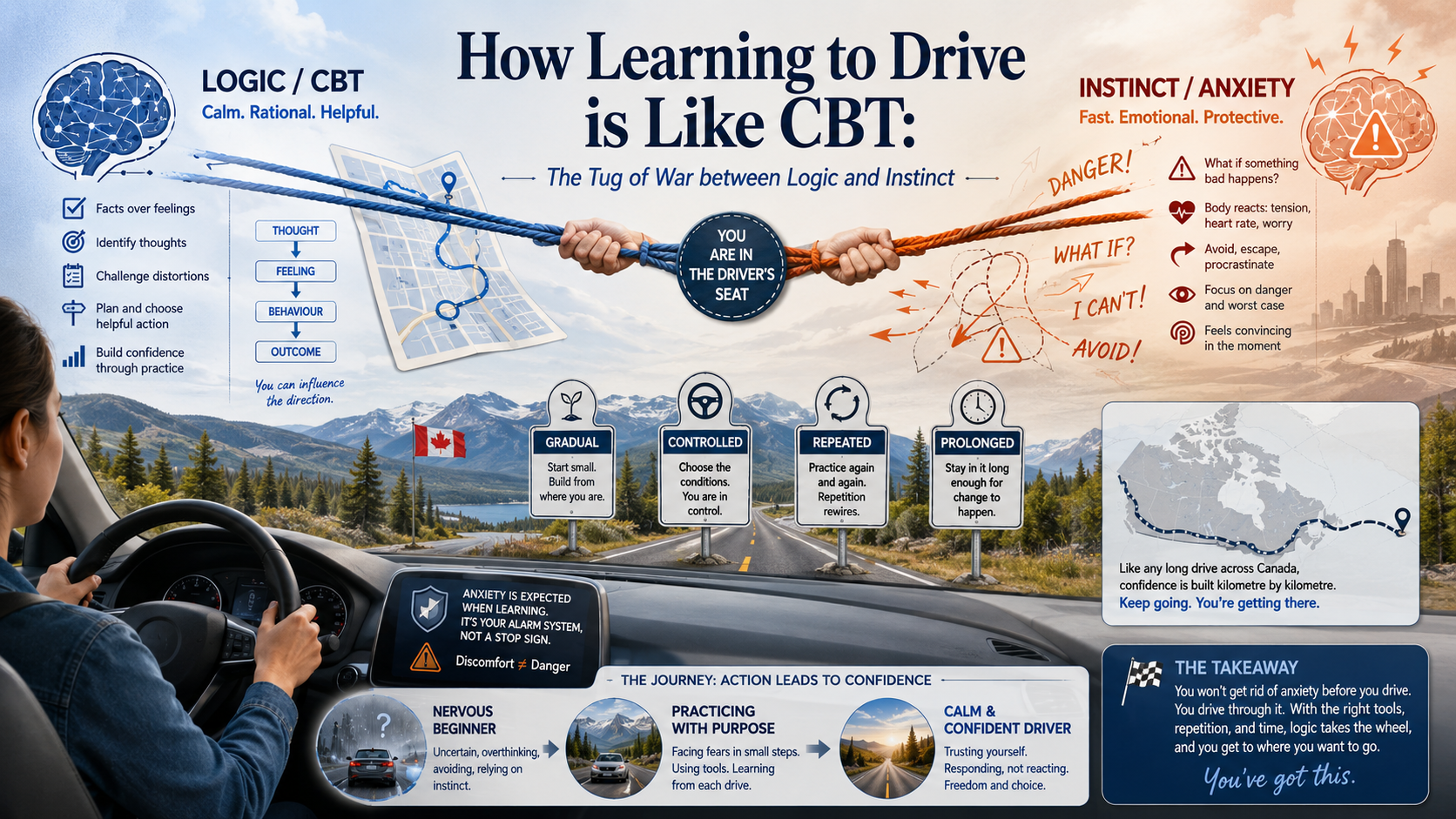
When we introduce behavioural exposure to clients, there are a few rules that are typically introduced to maximize the benefits of this technique. Specifically, for exposure to a feared situation to be effective, it needs to be gradual, controlled, repeated, and prolonged. One of the best ways to illustrate these rules is to use the example of learning how to drive a car. When first learning to drive, most people start on quiet streets or a deserted parking lot before building up to busy streets or highways (gradual), they choose which roads to travel on beforehand (controlled), they will practice often (repeated), and most driving lessons last approximately an hour (prolonged). We logically (and intuitively!) understand that our first experiences driving should not be on a busy highway, we shouldn’t be taken by surprise on our route (look! An unexpected 5-lane bridge!), we need to drive multiple times to become more comfortable, and a 5-minute spin around the block isn’t as helpful as a longer driving practice. Basically, all the major rules of exposure are nicely illustrated by the standard way in which most everyone learns to drive.
Expecting Anxiety in Challenging Situations
Another example of the clash between logic and intuition can be seen in our expectation of anxiety. Many people have an interesting reaction when doing something anxiety-provoking: they think that being anxious suggests that they are doing it wrong or shouldn’t be doing it at all. This gut tendency toward emotional reasoning can sometimes make exposure or behavioural experiments challenging, since we would necessarily expect clients to be anxious when doing something anxiety-provoking. And yet, I have heard from many clients over the years about supposedly unsuccessful attempts at facing fears due to the experience of anxiety in the moment. For example, one person told me that they had tried to overcome their bridge phobia by walking across a bridge once, but that it didn’t work as they were anxious the whole time they were on the bridge. This erroneous belief that the feeling of anxiety is inappropriate if feared situations are not in fact dangerous can (and should) be addressed through psychoeducation about anxiety and the principles of exposure.
Yet again however, the gut is best tamed by the rational mind when the example of learning to drive is introduced. If you ask a client about how they felt the first time they were behind the wheel of a car, they will probably tell you that they were anxious. If you then ask them if that meant they shouldn’t be driving, they will very likely tell you that isn’t so: they expected to be anxious at first since they were just learning, but that they felt less anxious over time. In other words, in this situation, the feeling of anxiety did not provide evidence that the behaviour was incorrect, but rather that it was novel and they were lacking in confidence, which is why they were anxious. So the logic that anxiety can be expected at the outset when facing a challenging situation trumps the instinctive reaction to believe the inverse when learning to drive is used as the illustrative example.
The Timeline of Confidence & Motivation
Finally, as CBT clinicians, we all know the challenge of encouraging clients to try a new behaviour in the absence of confidence or motivation. An individual’s gut reaction to trying out novel, unfamiliar, and sometimes unpleasant things is to aim to ‘feel ready’ and confident beforehand, such as wanting to be motivated before trying a new sport, going to the gym, or doing the dishes. This is understandable, and most everyone can instinctively relate to the desire to think or feel a certain way before acting. For example, we might prefer to be somewhat confident in our public speaking skills before agreeing to give a presentation at a conference. I personally find that it can sometimes be a challenge to convince someone that, contrary to popular opinion, motivation doesn’t precede action, it follows it. Yet the logic of CBT tells us that it is precisely through action, and experience, that we can develop motivation and confidence. So although our gut tells us that confidence should precede action, logic tells us it is the other way around.
The simplest way to demonstrate this to clients? You can return to the driving example yet again. I will often ask clients the following: what if someone had recently obtained a driver’s license but really did not feel confident in their driving skills. What would you think if they told you, “I’m really not feeling very confident as a driver, so I think I’m just going to wait until I feel confident, and once I do, I’ll get behind the wheel and start driving!” Most clients tend to laugh when I say this; this is because they instinctively see the problem with the statement. We tend to both logically (and intuitively) understand that if you wait to become a confident driver before you actually start driving, you will be waiting for quite a while. We understand that it is only through driving that we will ultimately build confidence, since it is through repeated practice and experience that our driving confidence increases. In other words, when it comes to learning how to drive, we understand that behaviour change precedes cognitive change – driving precedes confidence - not the other way around.
I personally learned this last lesson a few years ago when I drove from the West Coast to the East Coast of Canada. Before then, I did not drive very much, as I obtained my driver’s license a bit later in life, and was generally not a very confident driver overall. However nothing can increase your driving confidence quite like driving almost the entirety of the Trans-Canada Highway. My intuition and my logic agreed that this cross-country trip would help my driving confidence, and they were both correct. And that is perhaps a larger benefit of being a psychologist specializing in CBT: you sometimes have the opportunity to practice what you preach, and hopefully build up a few personal examples to illustrate the logic of CBT. Even if that means driving across Canada to do so.
