

Entering 2026: A Message from the President
As we enter 2026, I would like to wish you all a very happy New Year. In a period marked by uncertainty and change, the value of strong professional communities has never been clearer. CACBT was founded on the belief that collective effort strengthens our work. As a not-for-profit organization, we are grounded in a shared commitment to high-quality clinical practice and to letting science and compassion guide our work.
I truly hope to see many of you at the conference, held in a stunning setting at one of the most beautiful university campuses in the world, the University of British Columbia. A fun fact about UBC is that the famous “Love Experiment,” also known as the Misattribution of Arousal study, was conducted there in the 1970s on the Capilano Suspension Bridge. The study showed that people crossing a terrifyingly wobbly bridge were more likely to mistake fear for attraction. As it turns out, the findings for this study help to explain, in part, how I ended up marrying a Canadian and settling in Vancouver (ask me about this in person!).
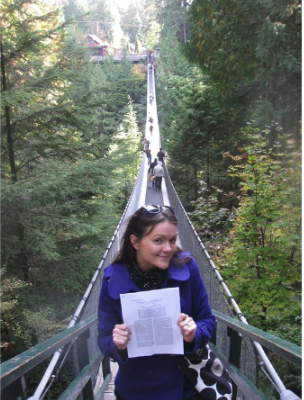
This is the Capilano Suspension Bridge where I am holding the Dutton & Aron 1974 paper
———————
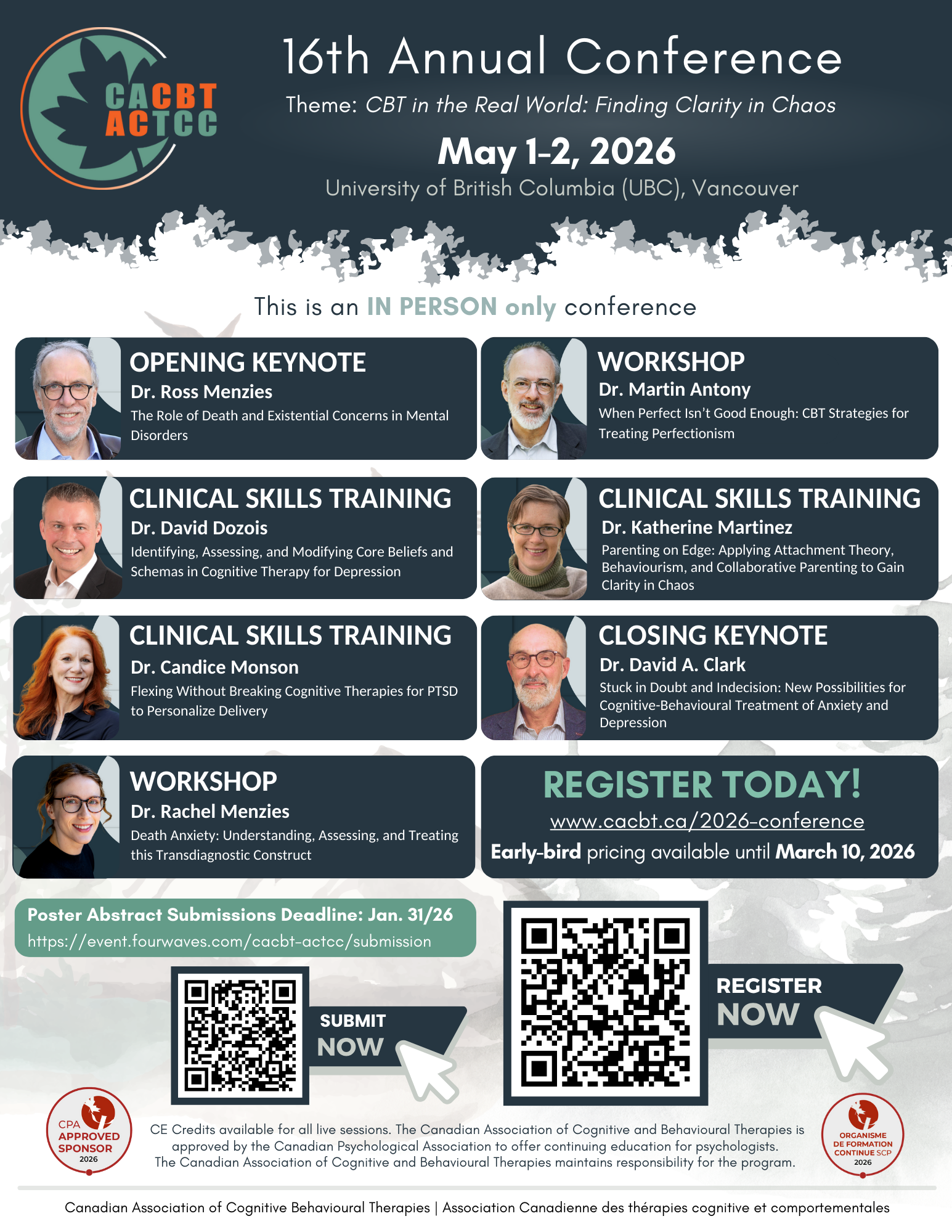
Advocacy is central to CACBT, and our annual conference is our main forum for this work. This year’s conference features an outstanding lineup of speakers addressing some of the most relevant and timely issues in everyday practice. Five years into the post-pandemic period, we are intentionally focusing on connection by hosting an in-person-only conference. This is also the first year we are offering an optional social program, including Opening Drinks and a Conference Dinner. We are also exploring the option of making recordings available for purchase for those who are unable to attend in person, to support accessibility.
I cannot speak about CACBT without thanking our Board for their hard work and dedication. Our association is run by some of the brightest and most committed people in our field, and it has been a genuine pleasure to work alongside you. CACBT is also incredibly fortunate to have our Executive Director, Diana Dunnell, who has been with the association for more than a decade, and our Executive Administrator, Jenaé Goffi, who has been with us for about four years. Their continuity, leadership, and commitment are a major reason CACBT continues to grow and thrive.
As we progress into the new year, please watch for more CACBT initiatives and opportunities for connection with the greater CBT community, including World CBT Day which will be held on April 7. If you haven’t already, please consider registering for the conference while Early Bird rates remain available. Our conference theme, CBT in the Real World: Finding Clarity in Chaos, continues to feel increasingly timely.
Finally, this is an important moment to choose Canadian and support evidence-based healthcare in Canada. In a time of global uncertainty, supporting Canadian conferences helps Canadian CBT thrive by strengthening our professional community and fostering collaboration within our healthcare system. After years of hybrid formats, this in-person-only conference refocuses on practitioner connection and collaboration, coming together in ways that are needed more than ever to support the future of evidence-based practice in Canada.
Warmly,
Fjóla Helgadóttir, PhD, R.Psych
President, Canadian Association of Cognitive and Behavioural Therapies.
