

Bridging the Gap: Why Certification Matters for Master’s Practitioners
By John Roche
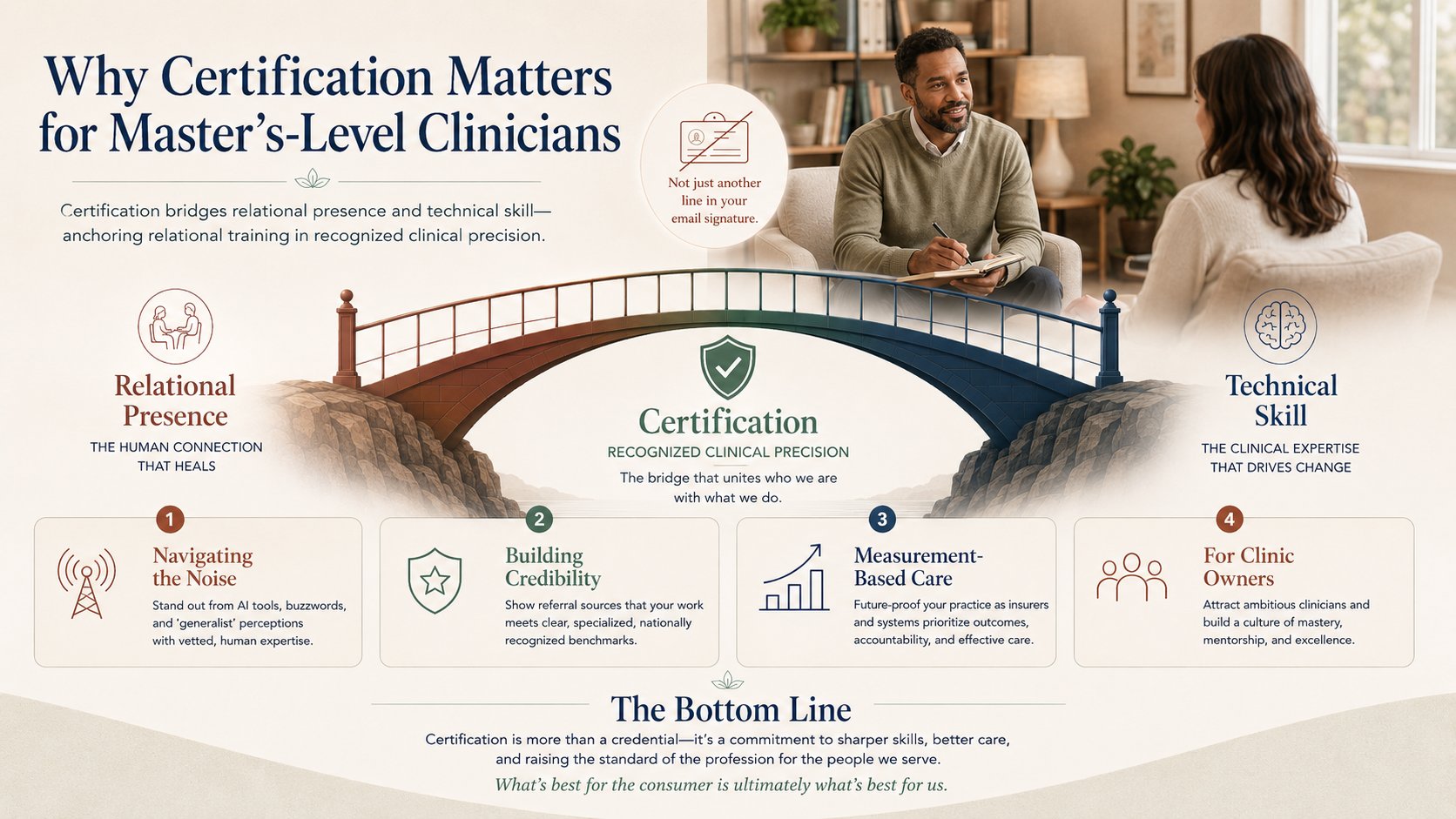
As a Master’s-level clinician who has navigated the rigours of becoming certified in a number of modalities, I’ve learned something: certification isn't about adding lines to your email signature to look impressive. For Master’s practitioners, certification is about bridging the gap between relational presence and technical skill in order to deliver the level of therapy your clients deserve. It anchors our rich, relational training in a framework of recognized clinical precision.
If you’re wondering why you should bother with the paperwork and the work samples when you are already a licensed professional, here are a few things to consider.
1. Navigating the Noise
The mental health landscape is changing rapidly. Between AI chatbots that can spit out a halfway-decent CBT worksheet and the rise of influencers who use clinical terms as mere buzzwords, the market is getting crowded and confusing for the public.
A professional license gets you in the door, but in a world of tightening budgets and increasing competition, it can sometimes be perceived as a "generalist" tag. Because Master's-level training is inherently broad and versatile, specialized certification is your way of saying, "I’m not just someone who uses these tools; I’ve had my work vetted by a nationally-established standard.” It elevates your foundational degree, providing verified, peer-reviewed human expertise in an era of digital noise.
2. Building Credibility with Major Referral Sources
Reliability is the currency of a successful practice. When professionals look for a place to send their referrals, they want to know the client is going to someone with a clear, proven plan.
When these referral sources see a CACBT certification alongside a Master's degree, the quality anxiety disappears. It demonstrates that your graduate-level clinical skills are backed by specialized, objective benchmarks. You are speaking the language of fidelity and proven outcomes. It turns a standard referral into a trusted partnership, ensuring that Master's practitioners are recognized as top-tier providers of specialized care.
3. The Shift Toward Measurement-Based Care
We are moving toward a global standard of "Measurement-Based Care." Insurance companies and third-party payers are increasingly looking for ways to prioritize effective, time-limited interventions.
Certification is essentially a pre-check for this new era. By proving your competence through a formal body now, you are future-proofing your practice. For Master's clinicians navigating a shifting regulatory and insurance landscape, this is a powerful asset. You aren't just reacting to the changes in the industry; you are positioning yourself as a leader who already meets the highest standards of accountability.
4. For Clinic Owners: Attracting a Standard of Excellence
If you are running a clinic, your greatest asset isn't your office space—it’s the quality of your team. If your practice looks just like the one down the street, you risk attracting applicants who are looking for a job rather than a career.
When you position your clinic as a hub for CACBT certification, you set a standard. You signal that you prioritize mastery over volume. This attracts the most ambitious, dedicated Master's-level clinicians—the ones who are hungry for growth, mentorship, and excellence. By fostering an environment of certification, you build a team that isn't just staffing a clinic, but is actively elevating the reputation of your entire practice.
The Bottom Line
At the end of the day, this isn't about professional hierarchies or ego. It’s about the person sitting across from us who is desperate for a way out of their suffering. Most clients don't know the nuances of our training, and they shouldn't have to. They just want to get better.
By bridging the gap between clinical heart and technical rigour, Master's practitioners aren't just making themselves more competitive—we’re raising the floor for the entire profession. What’s best for the consumer is, ultimately, what’s best for us. Certification is more than a credential; it’s a commitment to ensuring that our skills are as sharp as our clients need them to be.
